

Living in Dublin, Ohio, means downtown Columbus is close enough that sometimes an ordinary Tuesday night can turn into something a little more memorable.
Tuesday, October 20, was one of those nights.
My stepson James and I met downtown to watch the Columbus Blue Jackets take on the Toronto Maple Leafs at Nationwide Arena. The game was scheduled for 7:00 p.m., with Columbus welcoming Toronto to Nationwide Arena. Before the game, we went to Ted's Montana Grill across from the arena for dinner.
But I have always been fascinated by something else about going to a Blue Jackets game: the history underneath it.
When you walk through Columbus' Arena District today, surrounded by an NHL arena, restaurants, apartments, offices, and thousands of people coming downtown for sports and entertainment, it is difficult to imagine just how different this part of Columbus once was.
Before Nationwide Arena
Long before there were Blue Jackets jerseys and hockey fans walking down Nationwide Boulevard, this area was home to the Ohio Penitentiary.
The prison opened in 1834 and remained in operation until 1984. It stood vacant afterward and was eventually demolished in 1998 as redevelopment of the area was getting underway.
It also witnessed one of the darkest moments in Columbus history. In 1930, a fire at the Ohio Penitentiary killed 322 inmates, an event remembered as one of the deadliest prison fires in American history.
For decades, that enormous prison complex was part of the landscape on the northwest edge of Downtown Columbus. Today, the landscape could hardly be more different.
That is something I think about occasionally when I am walking through the Arena District.
Cities reinvent themselves. Sometimes dramatically.
Then Came the Blue Jackets
Nationwide Arena opened in September 2000, and the Blue Jackets played their first regular-season home game there on October 7, 2000, against the Chicago Blackhawks.
Twenty-six years later, James and I spent a Tuesday evening there. What developed around the arena became much bigger than a place to watch hockey. The Arena District became an entertainment neighborhood.
That is the part of the story that fascinates me. An area once dominated by a massive nineteenth-century prison is now one of the places people intentionally travel to when they want to experience Columbus.
Three Professional Sports Venues, One Part of Columbus
You can see that transformation simply by looking around. Three professional sports venues now anchor the same general downtown entertainment corridor.
| Venue | Team | Sport |
|---|---|---|
| Nationwide Arena | Columbus Blue Jackets | Hockey |
| Huntington Park | Columbus Clippers | Baseball |
| ScottsMiracle-Gro Field | Columbus Crew | Soccer |
The Arena District itself was developed as a mixed-use neighborhood around Nationwide Arena, rather than simply as an isolated sports venue. That distinction matters.
An arena can bring people downtown for a few hours. A neighborhood gives them a reason to stay.
Restaurants, entertainment venues, offices, residences, and public spaces have gradually turned what could have been simply “the place where the hockey arena is” into an actual part of downtown Columbus. Nationwide Arena itself describes the Arena District as a combination of restaurants, businesses, entertainment, and residential space.
That may be the most remarkable part of the transformation. People do not just go there because they have a ticket anymore. They go there because it has become a destination.
Columbus Has Changed
I grew up in Ohio, so I have watched Columbus change tremendously over the years. There are places around town where I can still mentally picture what used to be there. The Arena District is one of them.
It is easy to take the current version for granted.
That Tuesday, I headed downtown from Dublin and met James in the Arena District. Dinner at Ted's Montana Grill and the game at Nationwide Arena made for an evening in the very neighborhood whose transformation I have watched over the years.
Restaurants and a night of hockey. Blue Jackets sweaters everywhere. Cars moving through the parking garages. Music. Crowds. Lights.
We watched from Section 105, Row G, not far from the ice, our little piece of an arena with 18,500 seats configured for hockey. But this entire experience would have been unimaginable on that same piece of Columbus several decades ago.
That is what makes cities interesting. They accumulate layers. The buildings change. The roads change. Neighborhoods change. What people associate with a place changes.
But the history does not completely disappear. You just have to know where to look.
And That Night, It Was About James
Of course, none of that was really the most important part of the evening. The best part was considerably simpler.
I went to a hockey game with my stepson.
James and I got an evening together. We watched the Blue Jackets through the middle of the third period. The seats in Section 105, Row G put us close to the ice.
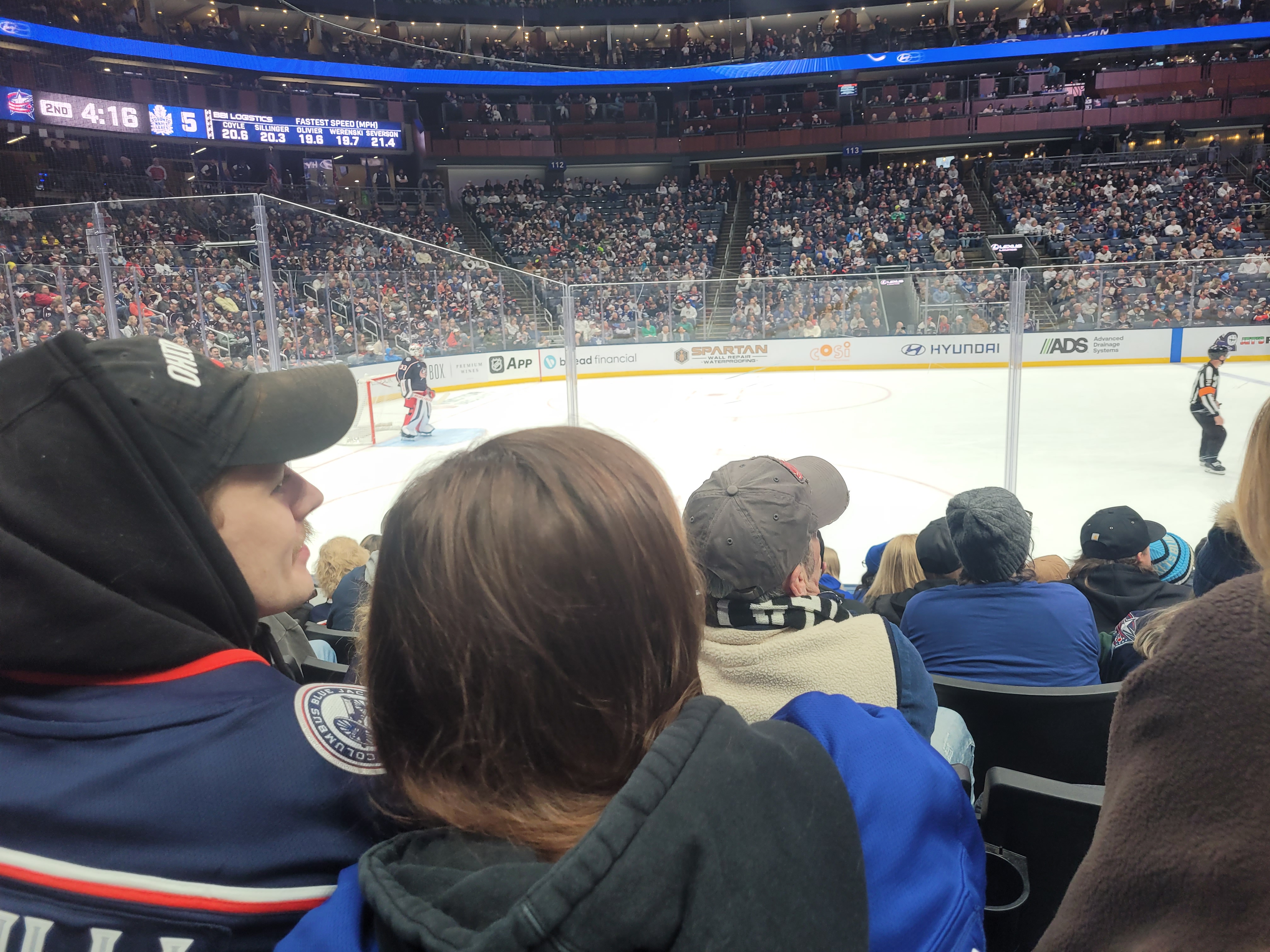
The game itself was not close. Columbus lost 6–2. It was not the result we would have wanted, but the evening was about more than the scoreboard. Someday the final score probably will not matter very much.
Dinner together before the game. Walking into the arena. Something funny that happened during the game. A goal. The crowd. The drive home.
Those are the details that eventually become the story.
A Pretty Good Tuesday Night in Columbus
That Tuesday evening brought together three things I appreciate: family, hockey, and Columbus.
We experienced them in a part of the city that tells a remarkable story of its own. From the Ohio Penitentiary, to Nationwide Arena, to an Arena District surrounded by professional hockey, baseball, and soccer. That is quite a transformation.
And on October 20, somewhere in the middle of all that Columbus history, there was a stepdad and his stepson watching the Blue Jackets play the Maple Leafs. We left midway through the third period, and the Jackets finished with a 6–2 loss, but that was not the only measure of the night.
Sometimes that is enough.
Actually, it is more than enough.
Go Jackets. 🏒