
A technical notebook became a much bigger story.
The archive now connects Microsoft 365, Azure, security, licensing, automation, certifications, personal technology, music, family, and the lessons that emerge when those interests overlap.
Six months does not sound particularly long.
Then I look at the archive.
There are now 141 posts organized across 13 topic areas, ranging from Microsoft 365 security and identity to Azure, licensing, Power Platform, certifications, AI, home technology, music, vinyl, family, and career reflections.
That is considerably more writing than I expected when I started.
My first major recap looked at the initial 60 days and was heavily centered on security, Power Platform, migrations, AI, Azure builds, and practical modernization. The 120-day recap showed the blog beginning to expand into licensing, governance, career history, certifications, personal technology, and a new professional chapter at Sycomp.
Now, at just over six months, another shift is visible.
The technical material is still very much here. In fact, it has become deeper. But the blog is also increasingly documenting why I am learning something, how different technologies connect, what I have learned from previous experiences, and occasionally what is happening away from the keyboard.
That feels like a much better representation of what this site has become.
Six months by the numbers
The current archive tells the story pretty well.
| Topic | Posts |
|---|---|
| Security & Identity | 17 |
| Endpoint Management | 17 |
| Power Platform, Dynamics & Automation | 17 |
| Azure, Cloud & Infrastructure | 16 |
| Licensing & Cost Optimization | 15 |
| Certifications & Learning | 15 |
| Music, Vinyl & Life | 10 |
| Copilot & AI | 9 |
| Home Office & Personal Tech | 9 |
| Migrations & Consulting Projects | 7 |
| Compliance & Data Governance | 6 |
| SharePoint, Teams & Collaboration | 6 |
| Career & Reflections | 6 |
Those numbers also need a little explanation. A post can naturally cross categories. A discussion of Defender for Endpoint, for example, can be equally relevant to Security, Endpoint Management, and Licensing. A Terraform article can be both Azure architecture and part of my ongoing learning journey.
The category counts therefore describe the subjects represented in the archive, rather than being numbers that should be totaled to calculate the 141 individual posts.
And that overlap may be one of the most important lessons from the last six months. Modern technology does not stay politely inside product boundaries.
Since the last recap: the blog found a wider voice
The August recap ended with a new chapter beginning at Sycomp and with the blog becoming more than a private technical archive. At that point I was already seeing some of my writing shared through the company, which gave the work an additional professional purpose.
The period since then has been different from the first four months. There has been less emphasis on simply documenting how to configure something and considerably more on understanding why technologies, architecture, licensing, governance, and operational decisions fit together.
Security expanded beyond individual controls
Security and identity remain one of the largest areas of the blog, now representing 17 archived posts. But the conversation has evolved considerably from the early security baseline work.
Recent articles have explored Microsoft Defender for Office 365 licensing, identity hardening, Defender for Cloud, Defender for Endpoint Plan 1 versus Plan 2, Secure Score, and the increasingly broad role of Microsoft Entra identity security.
That evolution culminated recently with my SC-300 renewal. The interesting part was not simply renewing another certification. Preparing for it reinforced how much the identity conversation has changed. Microsoft identity now intersects with authentication, governance, risk, applications, networking, monitoring, cloud access, and security operations.
Identity is no longer one piece of the security architecture. Increasingly, identity is the security architecture that connects everything else together.
Azure went from another topic to a major learning path
One of the clearest changes since the last recap has been Azure. Azure, Cloud & Infrastructure now contains 16 posts, making it one of the largest subjects on the site. Certifications & Learning has grown alongside it to 15 posts.
Earning Azure Fundamentals gave me the baseline vocabulary, but Terraform has forced me to understand the architecture at a much deeper level. I started by learning Infrastructure as Code and HCL. I quickly discovered that the Terraform syntax was not really the difficult part.
The harder questions were things like:
- What should this Azure architecture actually look like?
- Where should resources live?
- How should networks and subnets be structured?
- Which identities should have access?
- What dependencies exist between services?
- How should monitoring and security be handled?
- What happens when the environment needs to change six months from now?
That learning path produced posts on Terraform, Azure Arc, Azure Virtual Desktop, cloud capacity, hybrid and multicloud management, and most recently the Azure Well-Architected Framework.
I can read about a platform, earn the fundamentals certification, and understand the terminology. But trying to build it correctly exposes a completely different level of understanding. That is exactly what Terraform has done for Azure.
Licensing became one of the site's largest subjects
I probably would not have predicted six months ago that Licensing & Cost Optimization would become a 15-post category. In hindsight, it makes perfect sense. Licensing touches almost everything else.
Recent posts looked at Microsoft 365 Business Premium and Enterprise licensing, Microsoft Defender entitlements, Microsoft Security Copilot economics, the 300-user Business licensing limit, Windows 10 ESU and LTSC scenarios, SharePoint storage, Microsoft 365 Archive, Frontline licensing, NCE renewals, and FinOps.
There is little value in designing an environment that a customer cannot license, operate, or justify financially. The more I work across Microsoft 365 and Azure, the harder it becomes to separate the technical discussion from the licensing conversation.
AI became a governance discussion
The Copilot & AI category now contains 9 posts, but the evolution of that subject has been more interesting than the count. Early AI writing looked at Copilot adoption and consumption models. More recent posts have moved toward data protection, AI readiness, Microsoft Agent 365, Copilot Credits, Security Copilot economics, and why human oversight still matters.
The AI conversation increasingly starts before AI.
Readiness questions
Do you know where your data is? Do you understand who can access it? Are permissions under control? Are identities protected?
Governance questions
Do you understand the devices and applications accessing the environment? Can the organization govern what AI agents are allowed to do?
If the answer to those questions is unclear, adding AI does not fix the underlying problem. It can expose it much faster. That is why so much of my AI writing continues to circle back to identity, security, data protection, governance, and asset management.
The Microsoft-only walls came down a little
For most of my career, my technology world was overwhelmingly Microsoft-centric.
During the last several months, I have written about adding a Mac and iPad to that environment, Apple TV, smart-home technology, my basement workspace, computing history, and the broader impact of the AI infrastructure boom on everyday technology pricing. The Home Office & Personal Tech section now contains 9 posts.
None of that represents abandoning the Microsoft ecosystem. Quite the opposite. Using other platforms has made me look more critically at the experience Microsoft provides and has broadened how I think about interoperability, user experience, management, and the devices people actually choose to use.
Sometimes expanding your perspective simply requires being willing to use something different.
And then there are the posts that have almost nothing to do with work
This may be my favorite change since the 120-day recap. The archive now includes 10 posts under Music, Vinyl & Life.
There are stories about vinyl collecting, record stores, home audio, Ohio State football, pets, Columbus, and an evening at Nationwide Arena with my stepson. Even the vinyl collection made its way back into the technical side of the blog when it became the subject of a Power Apps solution and, later, a deeper technical blueprint.
Originally, I wondered whether those subjects belonged on a site that had become so heavily associated with Microsoft consulting. Six months later, I think the answer is clearly yes.
Technology is what I do professionally, but curiosity is what connects most of these subjects. I can spend one evening working through Terraform dependencies and another comparing vinyl pressings or adjusting an audio system. The topics are different. The tendency to understand how things work is remarkably similar.
Certification became documentation of the journey
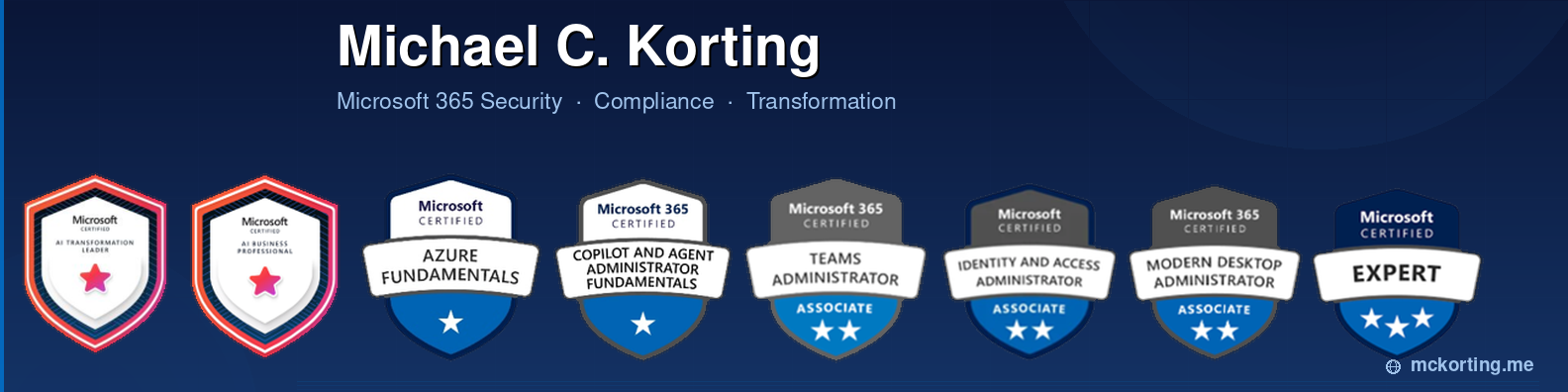
With 15 posts, Certifications & Learning has also become one of the largest sections of the archive. Those posts now cover everything from my earliest certifications and the road from Small Business Server through Microsoft 365, to Azure Fundamentals, MS-700, Microsoft 365 certification renewals, AI credentials, Purview, SC-300, and the Terraform learning path.
I have never viewed certification as the end of learning. If anything, the last six months have reinforced the opposite.
Certification
Gives me structure.
Labs
Create experience.
Customer work
Creates context.
Writing
Forces me to determine whether I understand the subject well enough to explain it.
Those four things reinforce one another. The certification posts are not really posts about passing exams. They are markers along a much longer learning path.
What the entire six months have really been about
Looking across all 141 posts, several ideas keep appearing regardless of the technology involved.
Security has to be operational
A control that cannot survive production reality is not much of a control.
Licensing is part of architecture
Entitlements, cost, security, and technical design cannot be separated cleanly.
Governance comes before AI at scale
Giving AI access to poorly governed information does not make the information better governed.
Automation requires architecture
Whether it is Power Automate or Terraform, automating a bad design simply makes it more repeatable.
Certifications are checkpoints
The real learning happens when the material gets applied.
Failure deserves documentation
Some of the strongest lessons come from designs that did not work as planned.
Technology should still be enjoyable
The curiosity behind Microsoft 365, Azure, and Power Platform also fuels the home lab, audio, vinyl, old computers, and smart-home projects.
141 posts later
When I published the 60-day recap, this site was already becoming a useful personal reference library. By the 120-day recap, it had also become part of my professional voice and my new chapter at Sycomp.
At six months, I think it has become something else again.
It is a timeline.
It captures technologies I was working with, things I was learning, shifts in the Microsoft ecosystem, consulting lessons worth remembering, career milestones, projects around the house, music I enjoy, places around Columbus, family moments, and occasionally mistakes that still have something useful to teach.
That mixture was not really planned. But it feels authentic.
Looking ahead
There is no shortage of material. Azure architecture and Terraform are clearly going to continue. Security, Entra, Microsoft 365 licensing, Defender, Purview, Intune, Copilot, AI governance, and Power Platform will remain central because those technologies continue to intersect with the consulting work.
I also expect the personal side of the site to continue. There will undoubtedly be more vinyl, audio, technology history, Columbus, home technology, and whatever else happens to be interesting enough to write about.
The goal is not to hit a particular post count. The goal is to keep learning and to leave behind a useful record of that learning.
Still, 141 posts in a little over six months is a milestone worth pausing for.
Thank you to everyone who has read a post, shared one, commented on LinkedIn, sent me a message, challenged an assumption, or simply encouraged me to keep writing.
The first 60 days proved I could keep the blog going. The first 120 days showed that it could become part of my professional journey. Six months later, it has become part of how I learn.
And I think that is a pretty good reason to keep going.